

Scorpio: the poison that precedes the nectar (Jyeshta nakshatra)
- Rebeca

- Jun 22
- 8 min read
Updated: Aug 4

Amrita is obtained by churning the ocean with the great serpent Vāsuki, and as Vimalananda points out "celibacy gives access to amrita". The practice of austerity and celibacy can be likened to the churning of the cosmic ocean for the recovery of amṛta, the nectar of immortality. Jyeshta, located in Scorpio, is a gandānta and an important zodiacal passage that leads one toward immortality. The uneasiness produced by this churning is one reason Jyeshta is not a particularly well-liked nakshatra. Scorpio is the seat of the serpent fire, the Kundalini, it’s the region of the zodiac where the Hālāhala poison emerges and where one must confront its destructive power. It represents the concrete manifestation of the six enemies of the mind (ariṣaḍvarga*) whose emergence compels one either to conquer them or be consumed by them. The stirring (churning) of the Kundalini brings a great deal of poison to the surface, although the cleaner the material sheaths, the less poison emerges and the sooner one reaches the treasures hidden within, and ultimately amṛta itself. We must therefore look to Śiva, Who alone was capable of controlling the poison. Śiva is associated with severe austerity, including the practice of celibacy. These are the requirements of Scorpio, it must learn to handle and control the poison of the six enemies of the mind. The Scorpio energy is therefore not merely necessary but essential for anyone seeking liberation. The challenges encountered here are internal rather than external as Scorpio demands confrontation with the shadow self.
Indra, the ruler of Jyeshta nakshatra, is related to indriya (the senses) which bind consciousness to matter, while mastery over them grants access to higher spiritual truths and even immortality. There is this extreme duality in the Jyeshta native who, like Indra, is capable of both great penance and of living a debauche life, but its inner motive remains the attainment of a higher spiritual goal. Scorpio is very much aware of this even when immersed in bodily pleasure. Sexually, this manifests as a desire both to dominate, and connect deeply with the partner. The water element shows the emotional aspect of the rashi which is very deep and secretive, being energised by the fire of Mars’ rulership. Thus Scorpios feel intensely; they love intensely, they hate intensely, and because of the intensity of their feelings they can become obsessive, jealous and possessive. Yet this same intensity can also translate into an intense love for God. So the nakshatra of intense devotion lies in the heart of Scorpio, Anuradha nakshatra, the nakshatra under which the personification of selfless love and intense devotion, Sri Radha, appears.
The Mūlādhāra chakra is connected to Scorpio because this is where the first stirrings on the Kundalini occur; it represents the activation of the serpent fire. This centre is located at the base of the spine near the anus and genitals, stirring the creative and sexual energy at the base. Its activation awakens sexual appetite as the individual develops an urge to engage this energy. This is a challenge Scorpio must pass through before ascending to higher states of consciousness. It is therefore futile for Scorpio to suppress its sexual energy; this is the part of the zodiac which teaches how to direct and transform the sexual energy which is a major theme for anyone who is practicing spirituality. The strong sexual appetite inherent in Jyeshta nakshatra is further highlighted by Indra’s rulership of the nakshatra, as he is the embodiment of virility, sustained and invigorated by the consumption of Soma. He is compared to a bull, is dominant, and is known for his high sex drive, yet he is capable of extreme austerity and possesses sharp intellect, mental vigour, and knowledge of occult sciences - these are the two sides that can be observe in the Jyeshta nativity. Other ways in which this sexual and creative force manifests is through intense researching, dissecting and digging into a subject of interest. In the case of Albert Einstein (Jyeshta Moon), that’s science; in the case of Mozart and Beethoven (both Jyeshta Moon), music. The native can thus become obsessed not just with a person but with any field of interest.
* The six enemies of the mind are: kāma (desire), krodha (anger), lobha (greed), mada (pride), moha (attachment), and mātsarya (jealousy)
Indra, sorcery & psychological warfare

Indra, ruler of Jyeshta, is the king of the gods, a great warrior praised throughout the Vedas for his strength, courage, and sovereignty. The gods themselves proclaim him "the most vigorous, most strong, most valiant, most perfect, who carries best out any work." They say "Let us install him (to the kingship over us)” (AiB 8.3.12). The Visvedevas declare that everyone should deem Indra supreme, the gods acknowledge his sovereignty and grant him many noble titles. He is especially praised for having killed the demon Vritrasura, an act that earned him great respect all over the universe. Because of Indra's influence over this nakshatra, Jyeshta natives possess strong will, sharp focus, and a drive to succeed. They don't like being second best and have to excel and stand above the crowd. Indra's love of wealth, intoxicants (soma), and pleasure reflects Jyeshta's strong appetites and intense nature; yet Indra's role goes beyond indulgence as he is responsible for maintaining cosmic order by defeating the demoniac forces. This is precisely the lesson of Scorpio; it's the sign where one must confront and overcome one's own inner demons. Bepin Behari writes about Jyeshta: "This is the end of the soul’s personal evolution; it is now open to other realms of existence. The spiritual transformation and adaptation to cosmic energy that happens under Jyeshta requires tremendous psychological growth".
One of Jyeshta's key characteristic is its connection to the occult, the hidden workings of reality, coming from both Indra and Mercury's rulership. Mercury gives curiosity, intelligence, and an interest in occult arts, and Indra is described as a master of māyā, capable of creating illusion to deceive and manipulate his enemies. Indrajāla, literally "Indra's net," refers to illusion, sorcery and magical deception, which is a siddhi that Indra himself possesses. Mercury wants to understand what is hidden while Mars (Scorpio's natural ruler) gives the courage to investigate. Jyeshta therefore possesses a natural affinity for hidden knowledge, whether it’s expressed through mysticism, tantra, or taboo topics. If they are not inclined to study of the occult, this same capacity can manifest as study of the unseen forces that shape human behaviour giving interest in psychology and a natural ability to influence and manipulate others through understanding how their mind works.

Yet the highest expression of Jyeshta is not mastery over others but mastery over oneself. Its śakti is the power to conquer the senses, which leads to siddhi. The native's greatest battle is internal as Scorpio brings one face to face with tendencies like envy, pride and the desire for control. This is why humiliation plays an important role in the development of the Scorpio, and especially the Jyeshta native. The native experiences scandals, humiliation, rejection, isolation, or situations that expose their weaknesses. These experiences force them to abandon false identities and confront themselves honestly. There comes a point where material achievements no longer satisfy and a deeper form of fulfilment must be sought. The native must become radically honest about their own flaws and inner enemies, because only what is acknowledged can be transformed. Jyeshta is not only observant of the outer world; it is capable of observing its inner world with equal intensity, identifying the obstacles to spiritual growth and devising ways to conquer them.
This combination of strength and depth often throws people off as Jyeshta natives can appear fierce, intimidating and worldly while simultaneously being very deep and genuinely spiritual. They are not easily impressed by empty piety and want genuine experience and real transformation. Like Indra himself, however, they must be careful not to become trapped by the desire for power, control, or quick results. The temptation to use occult means, manipulation, or force to achieve one's goals can become strong but the deeper path of Jyeshta is not domination over others but sovereignty over oneself.
Alaxmi & the path of the older sister
Then gods with their minds delighted, churned the milky ocean. Then Alaksmi, of a dark face and red eyes, having rough and tawny hair, and having an old body, sprang up. She, the eldest one, said to the gods: “What should I do?”
Alakshmī is among the first beings to emerge from the churning of the ocean. As the Samudra Manthana progresses, increasingly refined and auspicious elements appear. Alakṣmī represents the initial emergence of difficulty, obstruction, and inauspiciousness; she is also called Jyeshta (the eldest) because she is the older sister of Lakshmi (who presides over the opposite sign of Rohini / Taurus). As the goddess associated with poverty and misfortune, Alakshmī represents the difficult path of the elder sister who must endure hardship to make the way possible for her juniors. The archetypal older sister has a tougher upringing, she leaves home first, becomes independent, and must navigate life through her own effort, while the younger sister remains under parental care. The elder therefore develops resilience and independence through necessity; she acquires skills and experience that may later benefit and guide the younger sibling to help them avoid similar difficulties. Jyeshta represents precisely this archetypal pattern: the trials that must be faced alone in order to mature strength and independence, while also becoming a guide to others through your own experience.
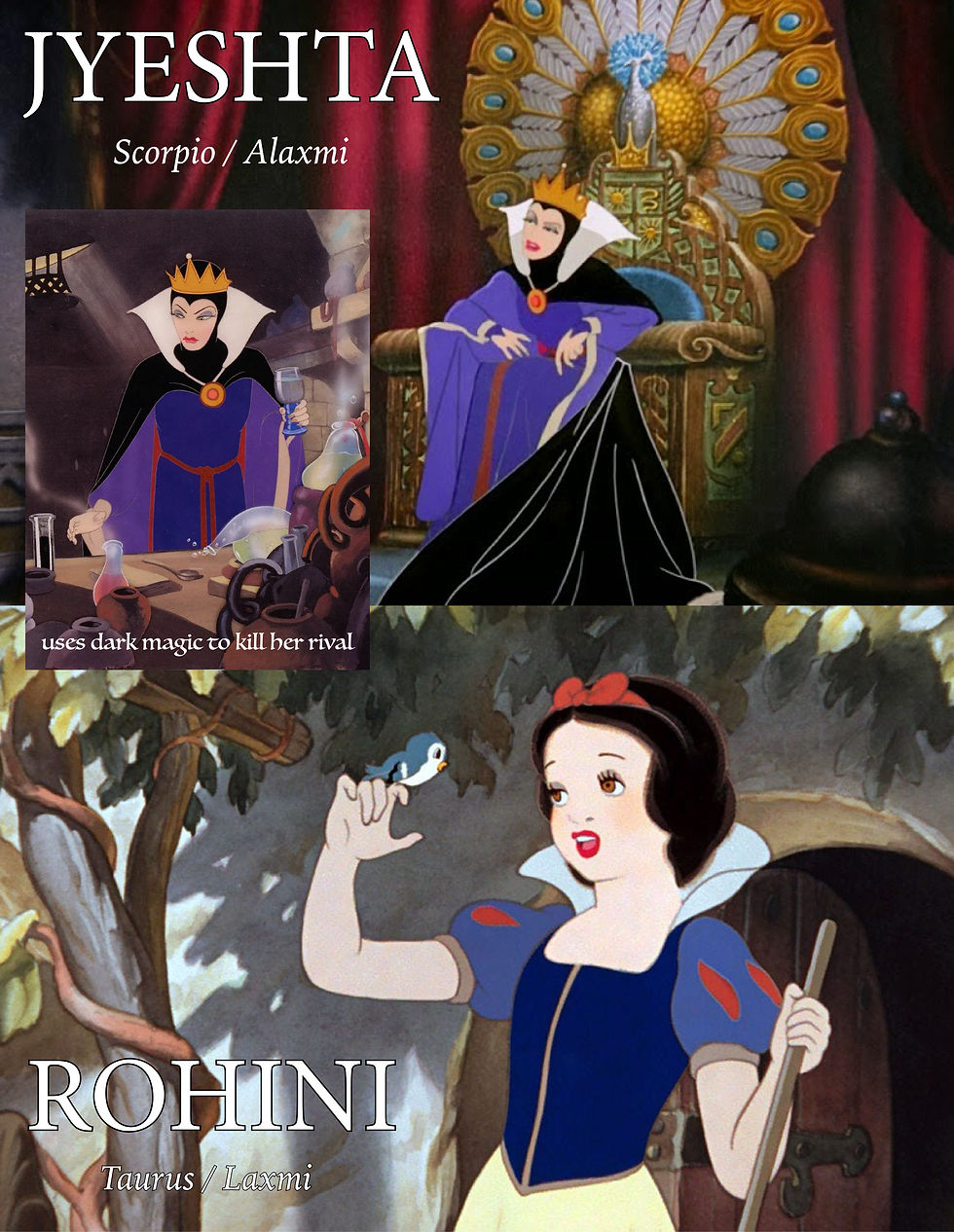
The polarity in the relationship between Rohinī and Jyeshtha can be observed in Snow White and the Seven Dwarfs, where Snow White strongly reflects Rohinī energy with her beauty, innocence and charm while the Evil Queen reflects Jyeshta energy in its unintegrated form (envy, jealousy, obsession with being number 1 and use of dark magic to destroy her rival). The Queen possesses occult knowledge and magical tools, including her mirror and various instruments of sorcery. Her desire to be “the fairest of them all” becomes an obsession, and when the mirror reveals that she isn’t, she is driven toward destruction of her rival. This reflects the competitive nature of Jyeshta and its fixation on being number one. Snow White’s innocence and naiveté stand in contrast to the Queen’s calculating, observant, and strategic nature which are all characteristics of Jyeshta nativity.
This story is reminiscent of the competition between Indra and Krishna (Rohini Moon and Ascendant). When Indra learned that the residents of Vrindavan had stopped making offerings to him because of Krishna's interference, he became very upset. As the king of heaven and controller of the rain, he tried to punish them by flooding the village. He wanted to destroy Krishna and the Vrajavasis to show them who's boss but despite all his efforts, Indra found himself unable to defeat this little Rohini boy which was a huge blow to his ego. Of course, Krishna is the Supreme God, but Indra did not know this. He simply could not accept being embarrassed in such a way. Eventually, he realised who Krishna truly was and surrendered to Him, showing the theme of humiliation Jyeshta natives often have to undergo in order to transform (ego death) and gain access to higher knowledge.
These examples illustrate the shadow expression of Jyeshta. A well-integrated Jyeshta is not merely destructive or competitive, it can become a powerful guide, protector, and support for those who are less experienced. In its higher expression, Jyeshta becomes self-sacrificial whether voluntarily or by circumstance, the one who bears responsibility so that others may follow more safely.


Comments